




Used Intsa 360 pro to capture live 360 media which was connected to WebRTC server
-
Captured live 360 video using Insta360 Pro, streamed through OBS Studio into a WebRTC server, received inside Unity and rendered as an inverted sphere texture so users feel physically inside the live environment.




End-to-end pipeline: Physical IoT sensors transmit via LoRaWAN gateway → ingested through Azure IoT Hub → stored in Azure SQL Database → Go backend aggregates with GCP Traffic and Meteosource Weather APIs → delivered to Unity XR front end in real time.
-
Multi-Source Go Backend Built a Go backend server using concurrent goroutines to manage separate data streams simultaneously, IoT telemetry via SQL connection, traffic data via Google Cloud API, and weather data via Meteosource API. Each stream had its own dedicated channel, ensuring one slow or failing source never blocked the others.
-
Used JavaScript inside Unity to act as a real-time control layer, parsing incoming JSON data from the Go backend and projecting different 3D environment renders, particle effects, and animations based on live sensor values. For example, rain particle systems by Meteosource weather data, or traffic overlays activated by Google Cloud API responses.
-
Real-Time Collaboration Features Implemented real-time shared state across 30+ concurrent users using Unity Netcode, all users in the same digital twin environment saw synchronized live data updates simultaneously.


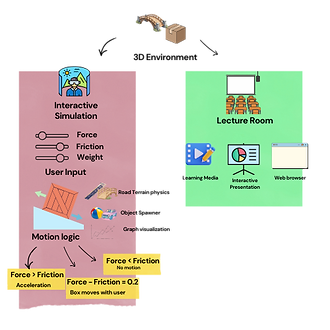
Developed immersive physics-based learning simulations in Unity (C#) for Meta Quest, visualizing force vectors, velocity, and acceleration in real time, improving student engagement by 40%
-
Developed immersive physics-based learning simulations in Unity (C#) for Meta Quest, visualizing force vectors, velocity, and acceleration in real time, improving student engagement by 40%
-
Used high-fidelity textures to render optimized force vectors suitable for XR rendering on constrained headset hardware


.png)
Validated the impact of high-fidelity mixed reality graphics on STEM comprehension across 3 cohorts of 50+ students, contributing graphics design frameworks published at IEEE Virtual Reality Conference
I implemented spatial occlusion using HoloLens's spatial mesh, so holograms correctly disappeared behind real physical objects rather than floating on top of them.
-
When users grabbed and dragged 3D equipment models using hand gestures, I had to render visual feedback, highlight shaders on the selected object, a connecting line from the hand to the object, and a snap indicator when the piece was near its correct placement location. Each of these was a shader effect that had to update every frame based on hand tracking data from HoloLens


In Lens Studio I built inference-driven AR, where a trained ML model's output directly controlled rendering decisions every frame on mobile hardware. Each one forced me to think about the rendering pipeline differently based on the display constraint."
-
I trained a custom Snap ML model for object recognition and connected its output directly to rendering decisions in Lens Studio. When the model detected a specific object, it triggered material swaps, visual overlays, and particle effects on the detected geometry, so the rendering state was driven entirely by ML inference output every frame.
-
The core rendering challenge was spatial alignment, taking the ML model's bounding box output in 2D screen space and correctly projecting a 3D overlay onto the detected object in world space. I had to account for camera intrinsics and depth estimation to keep the AR overlay locked to the physical object as the user moved.

Integrated Claude and OpenAI LLM APIs into live XR spatial computing environments, then built the validation layer around them, edge-case test suites, regression pipelines, and latency benchmarking to verify reliability under production load.
-
Built an agentic natural-language interface inside Unity that let users query and interact with their live XR environment using Claude API. The core engineering challenge was keeping AI query latency under 300ms while the rendering pipeline was simultaneously processing live geospatial telemetry and spatial anchor updates every frame.
-
Authored regression and edge-case test suites using Selenium WebDriver, Playwright, and Postman targeting AI pipeline endpoints across web applications, mobile interfaces, and XR environments testing malformed inputs, concurrent query loads, and degraded network conditions to verify the agentic workflow held up outside happy-path scenarios across all three surfaces.
-
Built automated CI/CD performance-regression pipelines on GitHub Actions CI/CD that benchmarked AI query throughput alongside rendering frame-time across device configurations, so a slow LLM response and a frame-rate drop could be correlated and diagnosed from the same report.
.png)